


The Rashtriya Swayamsevak Sangh (RSS), India’s largest Hindu far-right organization, initiated a well-funded lobbying effort in the U.S. earlier this year, a Prism investigation has found.
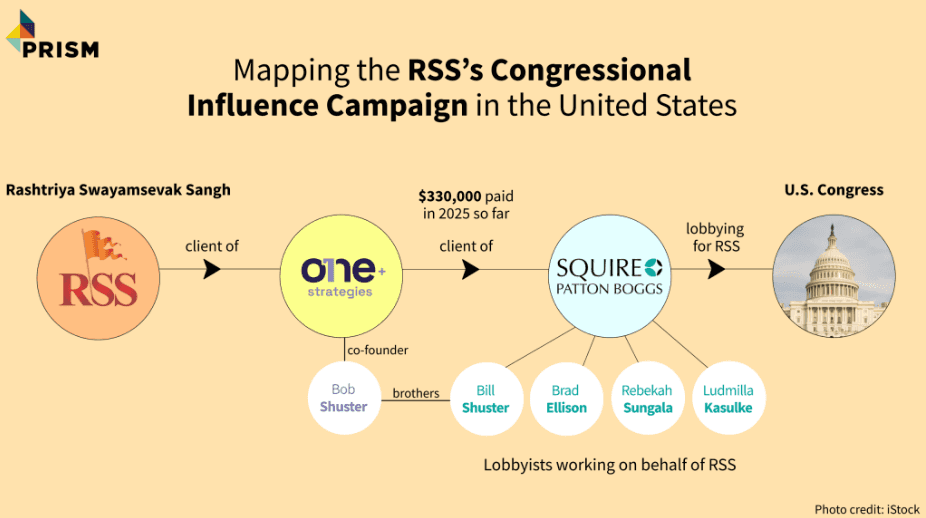
Prism is the first news outlet to report that Squire Patton Boggs, one of the top lobbying firms in the U.S., registered as a lobbyist on Jan. 16 for the RSS, according to lobbying disclosures. In the first three quarters of 2025, Squire Patton Boggs received $330,000 to lobby officials in the U.S. Senate and House of Representatives on behalf of the RSS, according to lobbying reports. This marks the first time the RSS has hired lobbyists in the U.S., according to public records.
In September, the RSS marked 100 years since its founding in 1925. The organization was established to promote what critics and human rights groups describe as a Hindu state; its followers have been accused of targeting Muslims and other minorities with discrimination, harassment, and violence. Indian Prime Minister Narendra Modi’s political party emerged from the RSS, and Modi himself was once a worker for the organization.
The RSS’s lobbying efforts in Washington, D.C., raise questions among experts on foreign influence operations about how the RSS has been able to conduct its activities without identifying as a foreign entity or without Squire Patton Boggs registering under the Foreign Agents Registration Act (FARA), a 1938 law that requires transparency from representatives of foreign interests. Public records confirm that neither Squire Patton Boggs nor any other organization is registered as an agent for the RSS under FARA. It is unclear whether Squire Patton Boggs is required to register as a foreign agent of the RSS.
The RSS and Squire Patton Boggs did not respond to Prism’s requests for comment.
The paperwork—filed under the Lobbying Disclosure Act of 1995 (LDA), a transparency law for activities to influence the federal government—does not list the RSS as Squire Patton Boggs’ direct client. Rather, the client is State Street Strategies doing business as the lobbying firm One+ Strategies on behalf of the RSS.
In Squire Patton Boggs’ lobbying registration form for the RSS, the general lobbying issue is noted as foreign relations, and the specific lobbying issue is “U.S.-India bilateral relations.” The focus on relations between the two countries strongly suggests that the firm’s activities should be registered under FARA, experts told Prism.
“Registering under the LDA and not FARA really keeps this influence campaign in the shadows,” said Ben Freeman, director of the Democratizing Foreign Policy program at the Quincy Institute for Responsible Statecraft and a leading expert on lobbying and foreign influence in the U.S. “And so, we really don’t have much idea at all about what [the lobbyists] are doing for the RSS.”
In India, the RSS has grown its influence in part by providing social services for local communities through charity programs, schools, and environmental disaster relief. In the U.S., however, the group has been the subject of political and media scrutiny in recent years over its ties to Modi, whose Hindu nationalist, anti-Muslim politics have turned the secular democracy into an “electoral autocracy.”
Raqib Hameed Naik, the founder and executive director of the Center for the Study of Organized Hate, a D.C.-based think tank that researches political extremism, said the RSS’s lobbying activities in the U.S. could be part of a campaign to alter how it is perceived outside of India.
“The RSS might have become a mainstream force in Indian politics, but globally, it is still seen as a fascist paramilitary group,” he told Prism. “So what they’re trying to do right now is to invest in changing the perception of the policymakers.”
Who are the RSS’s lobbyists?
Over the past century, the RSS has grown from a small, fringe volunteer paramilitary group into the most influential right-wing Hindu organization in India. The early leaders of the all-male organization praised Nazi Germany and fascist Italy, and a member of the RSS assassinated Mahatma Gandhi in 1948. Today, RSS members participate in drills and marches at training camps, and critics say the group’s methods of mass mobilization and targeting of minorities are rooted in its fascist origins.
The RSS serves as the ideological fountainhead of the broader Sangh Parivar, a network of Hindu right-wing organizations encompassing education, social services, and labor. A few years after India’s independence from British colonial rule in 1947, the Sangh developed a political wing in order to enter electoral politics. In 1980, erstwhile members of the political wing formed the Bharatiya Janata Party (BJP).
Critics accuse the RSS, the BJP, and its affiliates of instigating harassment and violence toward Muslims, Christians, and other religious minorities. Notably, those groups led a campaign to build a Hindu temple at the site of the Babri mosque in Ayodhya that culminated in the destruction of the mosque by activists in 1992, triggering a series of communal riots that were among the deadliest in Indian history. Last year, Modi attended the consecration ceremony for the newly built temple.
Since Modi and the BJP’s ascent to power in 2014, Indians have witnessed major democratic backsliding and a cascade of anti-minority politics and policies. The RSS remains closely linked to the BJP: Several of the party’s top leaders, including Modi, emerged from the RSS’s rank and file. “Their only interest has always been love towards the nation,” Modi said of the RSS at a centenary event in October.
While U.S. nonprofits have spread the RSS’s ideology among Hindu communities domestically, the RSS has now turned its attention to lawmakers.
According to quarterly lobbying reports, Squire Patton Boggs received payments totaling $330,000 during the first three quarters of 2025 for its work with the RSS.
Four Squire Patton Boggs lobbyists are listed in the reports: Bradford Ellison, Ludmilla Kasulke, Bill Shuster, and Rebekah Sungala. Ellison and Kasulke have experience lobbying Congress on behalf of foreign governments: Ellison previously represented Ethiopia and Benin, and Kasulke has represented South Korea and the umbrella organization for the Syrian opposition, according to FARA filings. Shuster served as a Republican congressman from Pennsylvania from 2001 to 2019; Sungala was a congressional staffer in his office. Bill Shuster’s brother Bob Shuster is a co-founder of One+ Strategies, the firm listed in the disclosures as working on behalf of the RSS. Neither the lobbyists nor One+ Strategies responded to requests for comment.
Email communications obtained by Prism, along with an article in an RSS publication, shed light on how Squire Patton Boggs and One+ Strategies have engaged with the RSS this year.
On Jan. 16, Ellison reached out to Audrey Truschke, a historian and professor at Rutgers University–Newark. Truschke, who has extensively researched the Hindu right, was contacted as part of the lobbyists’ efforts to conduct research about the RSS, according to an email obtained by Prism.
“Our team was recently retained by Rashtriya Swayamsevak Sangh (RSS) to educate lawmakers about RSS’s mission and impact, as the organization marks its centenary. This effort calls for us to develop a comprehensive understanding of RSS’s history, including historical controversies associated with the group,” Ellison wrote. “Accordingly, we would appreciate meeting with you in February to understand your perspective on the RSS’s history and current impact.”
Truschke’s reply was short. “Thanks for reaching out. Please let me know your status under FARA (Foreign Agents Registration Act) for this advocacy work.”
“I never heard back from them,” she told Prism.
In June, the Shuster brothers and Ellison were among the guests at an RSS event in Nagpur, India, where the group is headquartered. Neither the RSS nor local news reports indicated that the Shusters and Ellison are the RSS’s lobbyists.
The lobbyists visited an RSS training camp and met with members, according to an article in an RSS publication. The article called the visit “a significant moment in Indo-US civil society engagement, signaling growing interest among American policymakers in understanding India’s indigenous institutions beyond government and corporate corridors.” The article noted that the visit came weeks after a military conflict between India and Pakistan.
Also part of the “high-profile United States delegation,” according to the article, were Walter Russell Mead, a columnist at The Wall Street Journal, and Bill Drexel, a think tank specialist on U.S.-India relations. Mead and Drexel are both fellows at the Hudson Institute, a right-wing think tank based in Washington, D.C. Mead and Drexel did not respond to requests for comment.
The RSS also appears to have enlisted a pharmaceutical executive based in Massachusetts to help promote the group during its centenary.
The lobbying registration between Squire Patton Boggs, One+ Strategies, and the RSS lists Vivek Sharma as “an entity other than the client that contributes more than $5,000 to the lobbying activities in a quarterly period” and either participates in or supervises the registrant’s lobbying activities. Sharma is the executive chair of Cohance Lifesciences, a drug manufacturer based in Boston with major operations in India. The address given for Sharma on the form matches that of his company’s financial filing. Sharma has also been listed as a mentor of Ekal Vidyalaya, a U.S.-based nonprofit that reportedly has links to the Sangh Parivar and runs a network of schools in rural India that have been accused of imparting divisive teachings that preach Hindu superiority to children. Sharma did not respond to a request for comment.
In October, Jim Geraghty, a contributing columnist at The Washington Post, attended an RSS event in Nagpur marking the group’s 100th anniversary. Geraghty, who is a political correspondent for the conservative magazine The National Review, wrote in his column, “My trip was sponsored by the Hudson Institute and the Foundation for India and Indian Diaspora Studies, whose president is affiliated with RSS.”
The Foundation for India and Indian Diaspora Studies (FIIDS) is a U.S.-based nonprofit that regularly hosts events to “strengthen the U.S.-India partnership,” according to its website, featuring high-ranking Indian officials such as the country’s foreign minister and the ambassador to the U.S. FIIDS also brings together U.S. lawmakers to “underscore the deepening strategic and bilateral relationship between the two nations.” FIIDS is not registered under FARA.
The nonprofit’s president, Khanderao Kand, was reported as being a member of the Hindu Swayamsevak Sangh (HSS), an organization that has been likened to being the RSS’s branch in the U.S. Kand also reportedly served as HSS’s national public relations coordinator.
Hudson Institute, FIIDS, and Kand did not respond to requests for comment.
The RSS’s lobbying efforts have raised concerns among multiple experts about whether the activities fall under the purview of FARA.
Legal questions over foreign lobbying status
After reviewing the lobbying disclosures, three experts on foreign influence in U.S. politics told Prism that per lobbying regulations, the RSS would be considered a foreign entity and Squire Patton Boggs should be registered as a foreign agent for the RSS.
The registration form under the LDA asks if there is any foreign entity that holds at least 20% equitable ownership in the client or “directly or indirectly, in whole or in major part, plans, supervises, controls, directs, finances or subsidizes activities of the client or any organization.” In Squire Patton Boggs’ registration, there is a check in the box next to “No,” despite the RSS employing One+ Strategies, the listed client, to act on its behalf.
“This is clearly, just unquestionably, a foreign entity as far as the LDA is concerned. They should have checked ‘yes’ in that foreign entities box,” said Freeman of the Quincy Institute. “What matters is who the ultimate client is. And the ultimate client here, according to this document, is the RSS, which is a foreign entity.”
Squire Patton Boggs did not respond to a question from Prism about why the firm had not listed RSS as a foreign entity.
Dan Auble, a senior researcher at OpenSecrets who oversees the watchdog group’s lobbying database, told Prism that according to LDA guidelines published by Congress, the RSS should disclose itself as a foreign entity. “The guide is actually quoting the law itself,” said Auble, who also directs OpenSecrets’ Foreign Lobby Watch program.
The section in the guidelines on “Listing Foreign Entities” provides more specific guidance on what constitutes an indirect client. “The purpose of the disclosure is to identify the interests of the foreign entity that may be operating behind the registrant,” the document explains.
“If the RSS in India is funding or controlling the lobbying effort, or if they are affiliated and have a direct interest, then there should be disclosure of [Squire Patton Boggs’] ties to a foreign entity,” Auble told Prism.
When Squire Patton Boggs registered as a lobbyist for the RSS under the LDA, the firm entered the code for foreign relations as the “general lobbying issue area.” The “specific lobbying issues (current and anticipated)” is “U.S.-India bilateral relations.” In the subsequent quarterly filings, however, the specific lobbying issue is to “introduce the Rashtriya Swayamsevak Sangh (RSS) to U.S. officials.”
“My conclusion is that ‘U.S.-India bilateral relations’ is within the FARA rules. RSS should have been registered under FARA instead,” said James Thurber, distinguished professor of government emeritus at American University and a co-editor of the book, “Congress and Diaspora Politics: The Influence of Ethnic and Foreign Lobbying.”
Freeman agreed. “To me, what jumps out is that line in the registration statement where it does say their activities are U.S.-India bilateral relations,” he told Prism. “I can’t think of any exemption that they would fall under.”
Some firms registered under LDA can qualify for a FARA exemption. However, if a foreign government or a foreign political party is the principal beneficiary, this exemption does not apply. Because the disclosure mentions “U.S.-India bilateral relations” and the RSS has a close proximity to the ruling regime in India, Freeman said, “that raises a very important question of whether they should be registered under FARA and not the LDA for this work.”
The lobbying classifications matter, experts say, because registrants under FARA have to publicly disclose significantly more about which lawmakers they engage as well as other particulars, such as details of meetings, emails, texts, calls, receipts, transactions, and disbursements. Under the LDA, the RSS’s lobbyists do not need to disclose any such details.
The Secretary of the Senate and the Clerk of the House of Representatives, which administer the LDA, did not respond to requests for comment.
This is not the first time the lobbying activities of a Hindu nationalist organization have raised concerns over federal violations.
After operating in the U.S. for almost 30 years, Overseas Friends of the BJP-USA (OFBJP-USA) registered as a foreign agent of the BJP under FARA in 2020. OFBJP-USA has reportedly campaigned for the BJP, including during Indian elections. The group has also facilitated trips to the U.S. for BJP leaders, hosted them at events, and promoted them through social media initiatives.
In August 2020, an Indian news website reported that a member of OFBJP-USA criticized Joe Biden’s presidential campaign and his selection of Kamala Harris as his running mate. As questions were raised about the propriety of the member’s statement as a part of OFBJP-USA, the group clarified that his views did not reflect its own. Less than 10 days later, the group registered under FARA.
The Indian government, too, has hired lobbyists in Washington. India has long been represented by BGR Government Affairs, and this year, it contracted with two more lobbying firms. In April, the Indian Embassy signed a contract worth $1.8 million annually with SHW Partners. The firm’s activities for India include government relations and perception management, according to FARA filings.
Less than 10 days after President Donald Trump imposed a 50% tariff on India in August as alleged retaliation for India purchasing Russian oil during the Ukraine war, the Indian Embassy hired another lobbying firm, Mercury Public Affairs. The Indian government is paying Mercury $75,000 a month, per FARA filings, for services that include federal government relations, media relations, and paid advertising. The government of India did not respond to a request for comment about Squire Patton Boggs’ lobbying on “U.S.-India bilateral relations” on behalf of the RSS.
In February, the Trump administration took aim at FARA with a memo from Attorney General Pam Bondi that pared back enforcement of the law and disbanded the FBI’s Foreign Influence Task Force.
“The problem right now is that with Trump as the new president, he’s explicitly announced that he’s not going to actively enforce the Foreign Agents Registration Act,” Thurber said. The Department of Justice, which administers FARA, did not respond to a request for comment.
Despite the RSS lobbyists’ efforts to change the group’s image among U.S. lawmakers, Naik, of the Center for the Study of Organized Hate, said the influence campaign could easily be challenged by decades of publicly available information about the RSS.
“Documentation of a century of all their activities is literally available to anyone,” he said.

