


Introduction
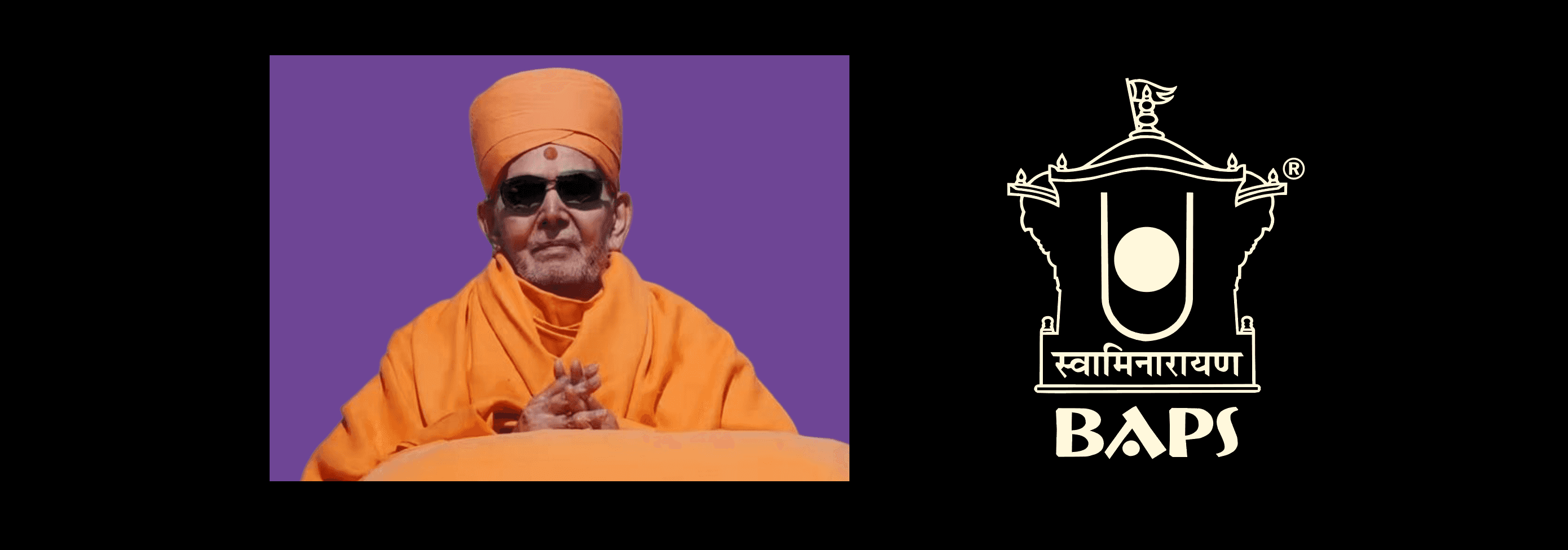
The Bochasanwasi Shri Akshar Purushottam Swaminarayan Sanstha (BAPS) organization, a Hindu sect based in Gujarat, India, burst into the limelight in the U.S. in May 2021. The FBI conducted a raid at a BAPS temple construction site in Robbinsville, New Jersey, to rescue about one hundred workers trapped in exploitative conditions, and consequently launched a criminal investigation that has continued for five years now.1
After the raid in May 2021, rescued workers filed a civil lawsuit against BAPS alleging forced labor, labor trafficking, immigration fraud, wage theft, and caste-based discrimination.2 Workers testified to working over twelve hours a day, seven days per week at an hourly wage of $1.20 per hour.3
Five years later, there is no official progress toward justice for the rescued workers, all of whom are Dalits (formerly Untouchables) and Adivasis (Indigenous), both historically marginalized communities.4 These communities are at the receiving end of discrimination not just in India, but also in the United States, where the Indian diaspora is largely from dominant caste communities.5
The only occasional update has come from attorneys, social workers, and community organizations who are relaying deaths - of at least eleven rescued workers thus far - from occupational illnesses that cannot be separated from their work at the BAPS temple.6 Since the raid, the rescued workers have been left in a multi-year limbo, which has inflicted on them psychological suffering, prolonged separation from their families, and financial hardship, amongst other struggles.
BAPS itself appears unscathed, proceeding to inaugurate not only the New Jersey temple in October 2023, but also temples in the U.S. such as in Alabama (June 2024) and Pennsylvania (June 2025).7 It has also announced the construction of temples in Massachusetts, North Carolina, and Minnesota.8 Internationally, temples were inaugurated in Abu Dhabi and announced in Bahrain and France.9
This case's objective is to demonstrate BAPS's increasing political clout and financial prosperity, while the civil suit stalls and workers perish. It shows how BAPS yields significant political support in both its country of origin (India) and the countries it is trying to spread in (particularly the U.S.). It examines how significantly BAPS has prospered financially over the last decade through its many non-profit organisations and limited liability companies. It aims to shed more light on the stories of the workers who have experienced exploitation and separation from their families, and are still waiting for justice.
History of BAPS Organization
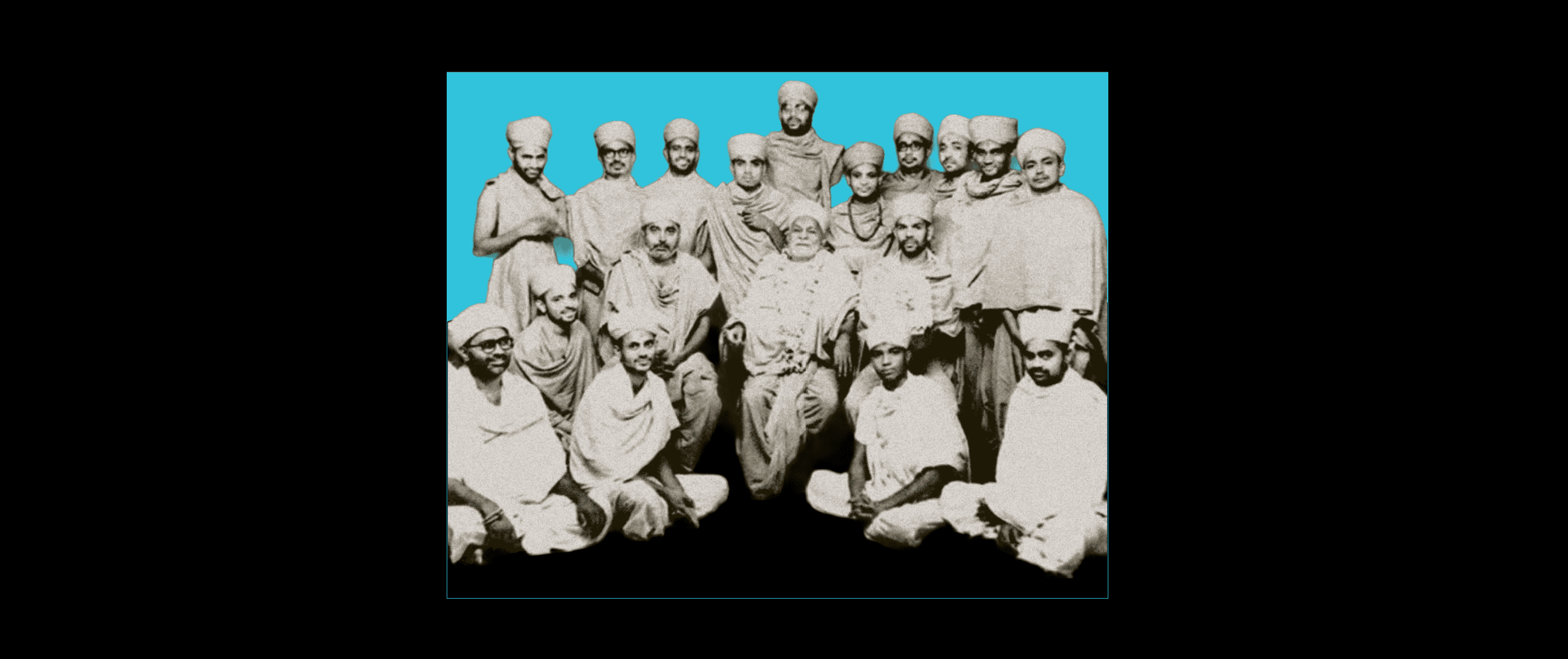
BAPS is a relatively new Hindu sect, formalised only about a hundred years ago in 1907.10 BAPS’s fortunes have grown tremendously alongside its political clout in both India and the United States. Its presence in the United States began with the inauguration of the first BAPS temple in New York City in August 1974.11 Over the years, BAPS has built more than 100 temples and centers in the United States and Canada.12
The social base of the devotees is aligned along class and caste lines. Historically, this sect gained large support among agrarian and mercantile communities in Gujarat. This support shaped its culture to focus on economic success, social mobility, and resource accumulation.13 Consequently, this base has economically prospered both in Gujarat and the diaspora.14 BAPS is commonly viewed as a wealthy sect, and its temples are known to be large, ornate, and expensive.15
For all its wealth, plaintiffs testified that BAPS orchestrated their recruitment on R-1 religious visas and compelled them to perform construction labor at temple sites for as little as $1.20 an hour, under coercive and restrictive conditions.16 The allegations against BAPS are for violations of the Racketeer Influenced and Corrupt Organizations Act (RICO), the Trafficking Victims Protection Act (TVPA), the Fair Labor Standards Act (FLSA), and State Wage and Hour laws.17 All the workers are either Dalit or Adivasi communities, which are historically marginalized within the caste hierarchy.
Though horrendous, this is not unsurprising given BAPS’s sordid history in upholding the supremacist and hierarchical caste system.18 Temples have been heavily segregated in India due to upper-caste communities enforcing the caste system, and Dalits have been banned from BAPS temples from the start.19 Progressive anti-caste movements have fought for, litigated, and advocated for all people being allowed entry into temples as universal spaces of worship. BAPS even pursued legal action up to the Bombay High Court to stop Dalits from entering BAPS temples, which they lost in 1958.20
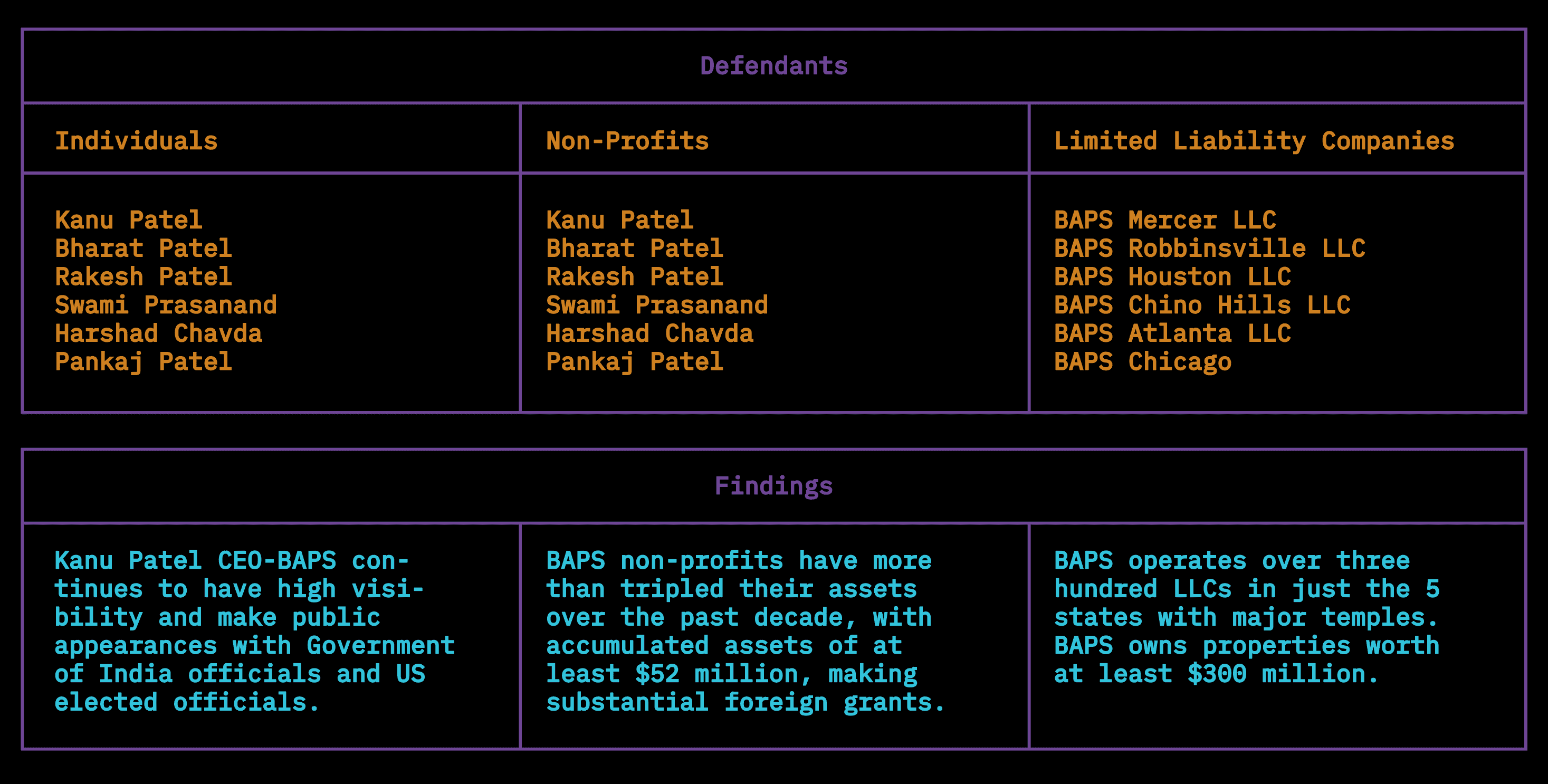
The current lawsuit has three categories of defendants: individuals, non-profits, and limited liability companies (LLCs).21 This lawsuit underscores how BAPS is not just a temple, but a hydra-headed entity committed to a political agenda. It operates through a complex organizational structure that includes a lobbying arm, nonprofit religious entities, and affiliated for-profit ventures.
As detailed in the next sections, these entities continue to prosper financially and flex their influence in the public sphere - from arranging visits of influential politicians and government officials to temples, to major grant-giving to both domestic and foreign entities outside the United States, and announcing even more high-value tax-exempt temple constructions.
This growing clout has coincided with the stalling of the civil suit. In the media sphere, two major narratives dominate: that workers have withdrawn from the case, and that BAPS has been cleared of all charges.23 Both are untrue.
Twelve out of the over one hundred workers in the civil suit did withdraw in July 2023, but the majority remain. All of the plaintiffs who have so far withdrawn from the case are workers who returned to India. Given BAPS’s significant political influence inside and outside of India, it seems very possible that these withdrawals were under coercion. As the plaintiffs’ attorneys submitted in court, “plaintiffs do not know what compensation, if any, these twelve individuals might have received in exchange for the dismissal of their claims.”24
In September 2025, BAPS issued a statement that the investigation against them was closed, which received wide media traction.25 The Trump administration's Department of Justice did not issue a press release, but instead this news broke via BAPS attorneys’ submissions in court.26 BAPS then promptly filed to have the case dismissed.27 The plaintiffs have strongly opposed this, requesting oral arguments on wage claims, caste discrimination, and trafficking.28

Political Influence
BAPS Political Influence in the US
Less than two and a half years after the raid, BAPS proceeded to inaugurate the Robbinsville temple, opening it to the public in October 2023. The inauguration, spread out over three months, was a show of political strength, with US government officials playing a key role in legitimizing BAPS.29 BAPS Public Affairs, their federal political action committee (PAC), publicised the attendance of more than forty current and former elected representatives, including Steny Hoyer (D-MD), former House Majority Leader; Frank Pallone (D-NJ); Raja Krishnamoorthi (D-IL); and Ro Khanna (D-CA).30 Former members of Congress included Ted Deutch, current CEO of the American Jewish Committee. Also in attendance were United States Senator from New Jersey, Cory Booker, as well as former Acting Attorney General of New Jersey, John Jay Hoffman.31 Randhir Jaiswal, then Consul General of India in New York, was also present at the inauguration.32 BAPS further publicised glowing testimonials from Ashesh Badani, Chief Product Officer at Red Hat, and Bharat Patel, Chairman of Asian American Hotel Owners Association.33
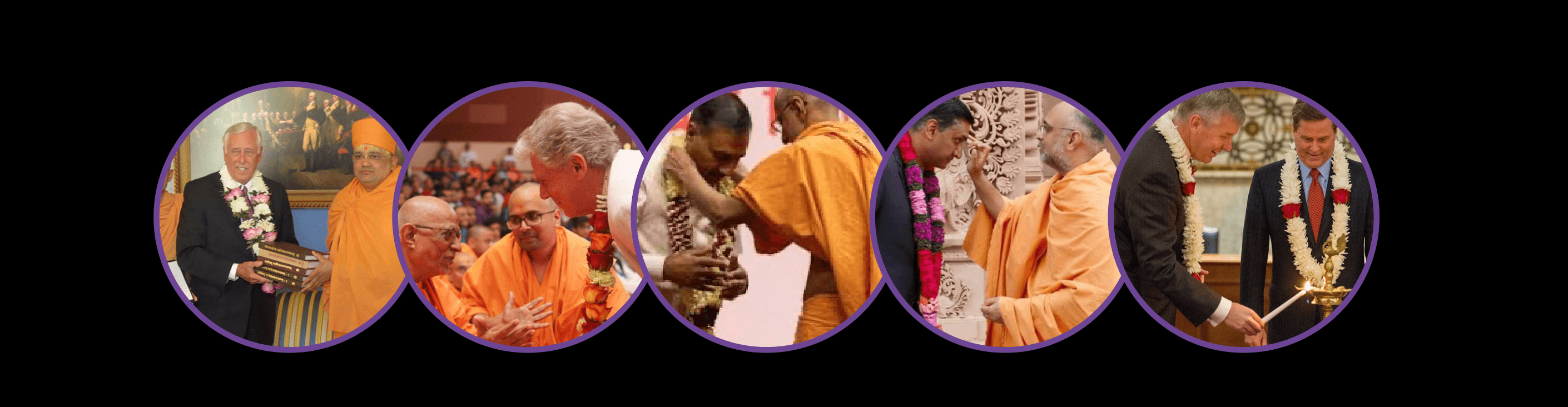
Set up in 2020, the BAPS Political Action Committee started spending during the 2020 Presidential elections and increased its spending for the 2024 presidential elections.34 It made contributions to candidates across the aisle, with slightly more to Republicans than Democrats, amounting to over $135,512.35 After the presidential elections in November 2024, BAPS received two high-profile visitors from the Trump administration, Tulsi Gabbard, Director of National Intelligence, to the Robbinsville temple in December 2024 and JD Vance, the Vice President of the United States, to the Delhi temple in April 2025.36 Ms. Gabbard is a practising Hindu and her ties with the RSS (Rashtriya Swayamsevak Sangh), the far-right Hindu nationalist paramilitary group in India, are well-documented.37
BAPS has facilitated visits of American elected representatives to temples in both the United States and India, starting way back in 2001 with then President Bill Clinton, who visited the BAPS temple in Gujarat.38
Serving governors of Delaware and New Jersey have visited both the temples in Delhi and New Jersey.39 Delaware is a state in which over a hundred BAPS-related entities are registered, including most of the limited liability companies named as defendants. Kanu Patel, the CEO of BAPS and defendant in the lawsuit, accompanied Governor Phil Murphy during this visit to the Robbinsville temple.40
Ro Khanna (CA-17) and Michael Waltz (FL-06), the then co-chairs of the bipartisan Congressional Caucus on India and Indian Americans, visited the temple in Delhi in August 2023.41 Two months later, Ro Khanna attended the Robbinsville inauguration.42
Post-inauguration, BAPS focused its public efforts on its fifty-year anniversary in the United States. BAPS put out statements claiming it managed to successfully pass resolutions in both New York and California state assemblies marking its fifty-year anniversary.43 BAPS also introduced a congressional resolution, which did not pass, to celebrate “principles of democracy, religious pluralism, human rights, and the rule of law shared by both the United States and India”.44

BAPS Political Influence in India
The run-up to the New Jersey temple inauguration included several meetings between BAPS and the Prime Minister of India, Narendra Modi, as publicised by BAPS. In July 2023, BAPS leaders met with the Prime Minister in Paris.45 A few weeks later, Swami Brahmaviharidas met the Prime Minister again in Delhi.46 Three days later, Swami Brahmaviharidas and the Prime Minister met again in South Africa, on the sidelines of the BRICS summit.47 For the inauguration, BAPS publicised messages of congratulations from Prime Minister Modi.4849
Swami Brahmavihari kept up these public visits, and met again at the Prime Minister’s residence in March 2024 and April 2025.50 BAPS spares no opportunity to make known its proximity and access to the Prime Minister. BAPS thus demonstrates its influence across administrations - Democratic and Republican- and continues to stay close to Modi into his third term as Prime Minister. This slew of people's elected representatives in turn have willingly and visibly aligned themselves with BAPS.
BAPS marked the first anniversary of the Robbinsville temple inauguration with a visit by 14 Consul Generals. By this time, their regular visitor Randhir Jaiswal was back in Delhi, but this event was attended by the Deputy Consul General of India, Varun Jep.51

Organisational Structure
BAPS Nonprofits
Directories for non-profits and state registries for limited liability companies throw up hundreds of entities with “BAPS” and “Swaminarayan” in their name.52 Closer scrutiny shows clear links to BAPS defendants - by shared addresses and key personnel - but limited financial information, partially due to exemptions to disclosure of being classified as a religious organisation.53
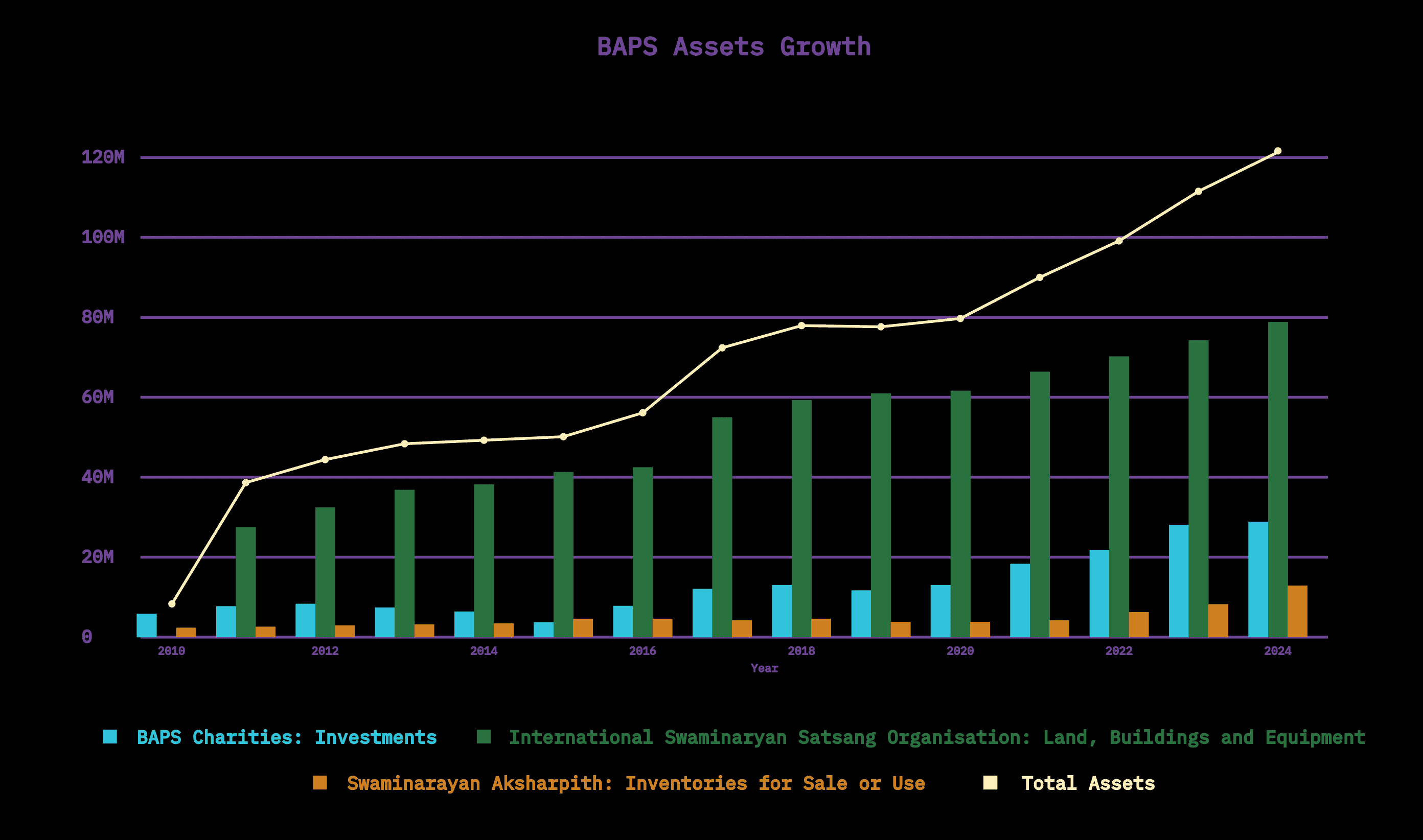
Despite these limitations, some financial information about three BAPS-affiliated 501(c)(3) organisations is available: BAPS Charities, BAPS Endowment and BAPS Aksharpith. Together, their assets are worth about $52 million, which marks over a five-fold increase since 2010.54
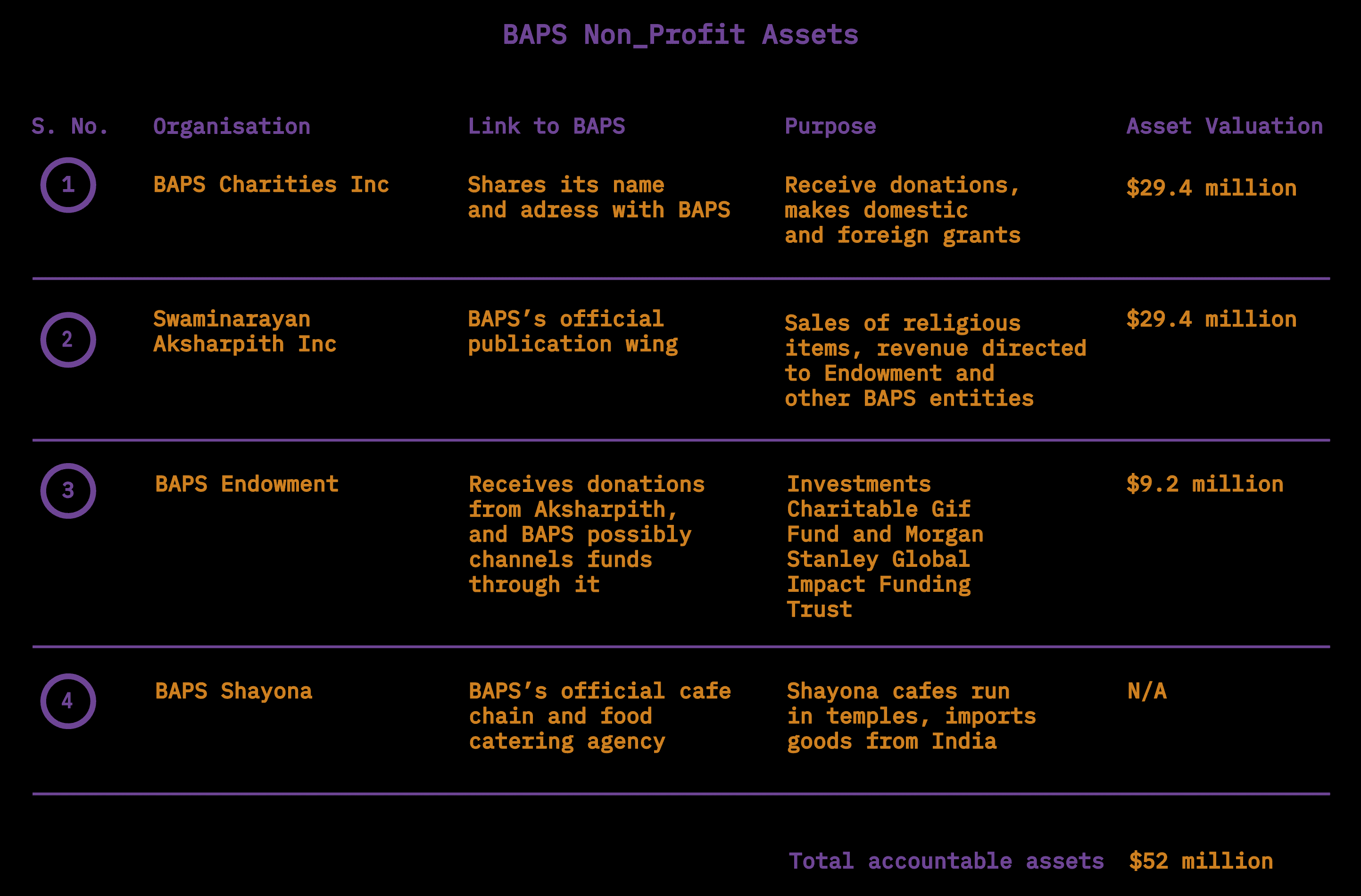
Each of these entities appears to be set up for a specific purpose, with funds moving readily between them.
- BAPS Charities holds assets primarily from investments in securities markets and contributions. In turn, it makes grants to domestic and foreign organisations.60
- Swaminarayan Aksharpith holds assets and revenue from the sales and inventory from “selling religious items and medicines related to its religious tenets.” It directs much of its earnings to BAPS Endowment and other BAPS entities.61
- BAPS Endowment has the least information available on it, but it appears to be set up to channel funds to BAPS through other organisations.62
A closer look at these entities shows some key operational strategies.BAPS Charities has expanded its assets significantly - from $6 million in 2010 to $29.4 million in 2024.63 These assets are largely investments in securities and cash. Its revenue stream is largely donated contributions. BAPS also advertises matching gift programs for the employees of a wide range of companies.64
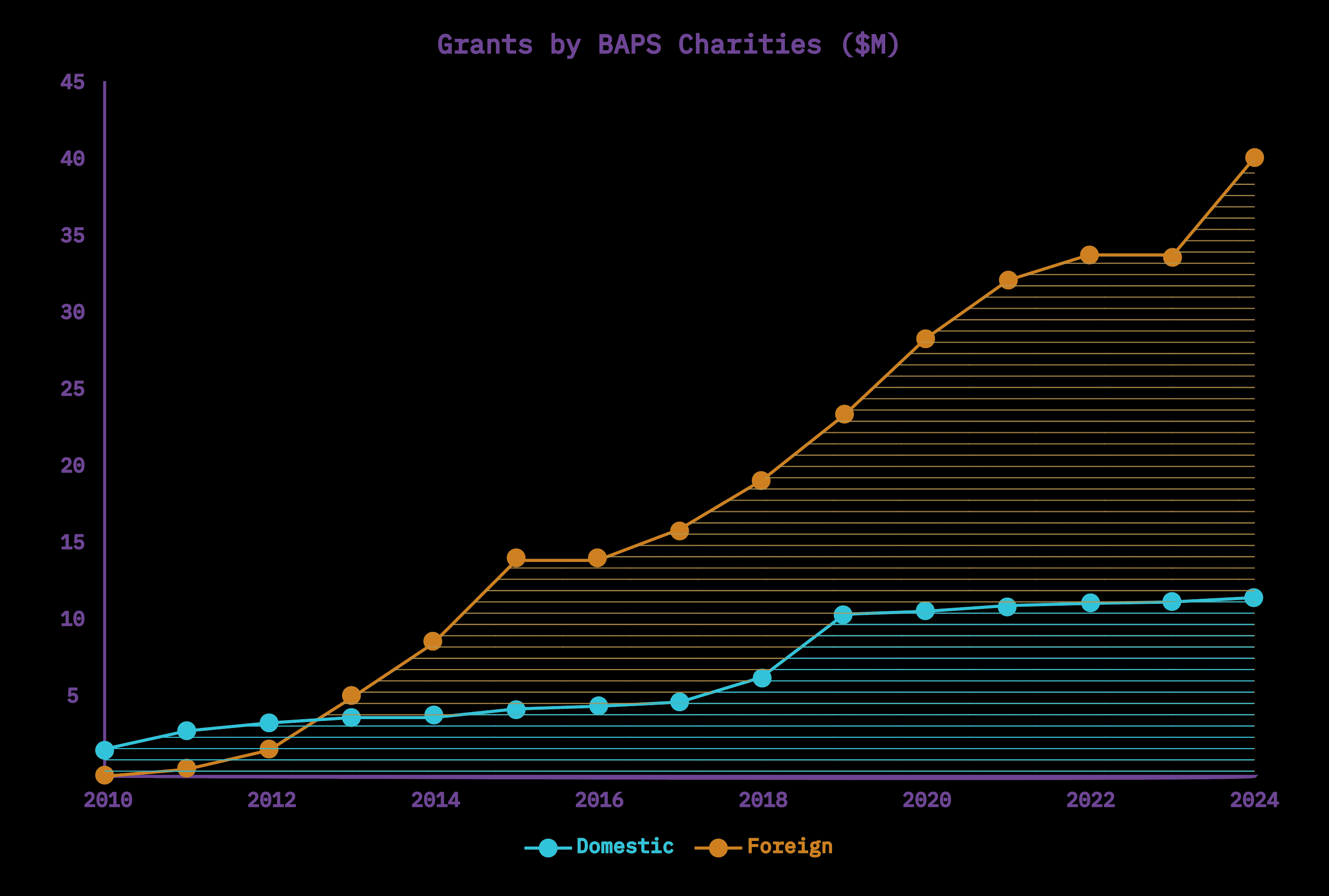
BAPS Charities’ expenses appear to be mostly grantmaking rather than operational expenses. BAPS Charities makes grants to a variety of domestic and foreign entities. Some domestic grantees are American Cancer Society, Emory University, SAKHI for South Asian Women, Community Addiction Recovery Efforts, Los Angeles County Fire Department, American Jewish Committee, United Nations Refugee Welfare Association, Robbinsville Board of Education and Tiger Woods Foundation.65
Although the names of BAPS's foreign grantees are not available, BAPS Charities has recently seen a drastic increase in its foreign grants from $1.5 million in 2022 to $6.3 million in 2024.66 For the data available over the past decade or so, BAPS Charities has made a total of $40 million in foreign grants, compared with just $11.5 million in domestic grants.67
BAPS Aksharpith is the sales arm that describes its organisation's mission as being to “provide support for the Hindu faith through preparing and selling religious items and medicines related to its religious tenets."68 Its revenue is largely from inventory and sales. Since 2010, its revenue has amounted to $31 million, following a general upward trajectory year on year.69
In addition to these major non-profits, two more appear significant - BAPS Endowment and BAPS Shayona. BAPS Endowment has no direct information available on its financial transactions, but some major donors can be pieced together from their own disclosures. For example, BAPS Aksharpith regularly directs funds into the Endowment (at least $2.3 million over the last few years).70 Donor-advised funds of Fidelity Investments Charitable Gift Fund and Morgan Stanley Global Impact Funding Trust have channeled at least $5.5 million over the past few years.71 Private foundations of Vallavbhai and Savitaben Patel Foundation Inc, Shah Family Foundation Inc, Shivashakti Foundation and Pratima N Shah Family Foundation are also major millionaire donors to the endowment, about $1.4 million collectively.72 The BAPS website has a detailed advisory on how to donate stocks to BAPS Endowment.73
There are various entities registered under the name BAPS Shayona across states. This likely refers to the Shayona Cafes present in multiple temple complexes that sell their own proprietary snacks, groceries, and food, imported from India.74
BAPS LLCs
Turning to the limited liability companies listed as defendants, plaintiffs submitted evidence showing that all the temple-owning entities—BAPS Atlanta LLC, BAPS Chino Hills LLC, BAPS Houston LLC, BAPS Chicago LLC and BAPS Development LLC—were registered at the same address, “81 Suttons Lane, Piscataway, NJ 08854-5723,” and several were incorporated on the same day, November 7, 2007. Most are incorporated in Delaware.75 Nayan Sarothia is listed as the agent for all of these LLCs.76 At least 97 BAPS-related entities are registered by him in Delaware.77
We searched through state registries of all five states with major temples and defendants in the case - California, Georgia, Illinois, New Jersey, and Texas and found over 251 LLCs that are likely linked to BAPS.78 Several LLCs' names were repeated across registries, but each has a separate identification number. We observed a pattern of multiple LLCs being registered by the same agent, or to the same address.79
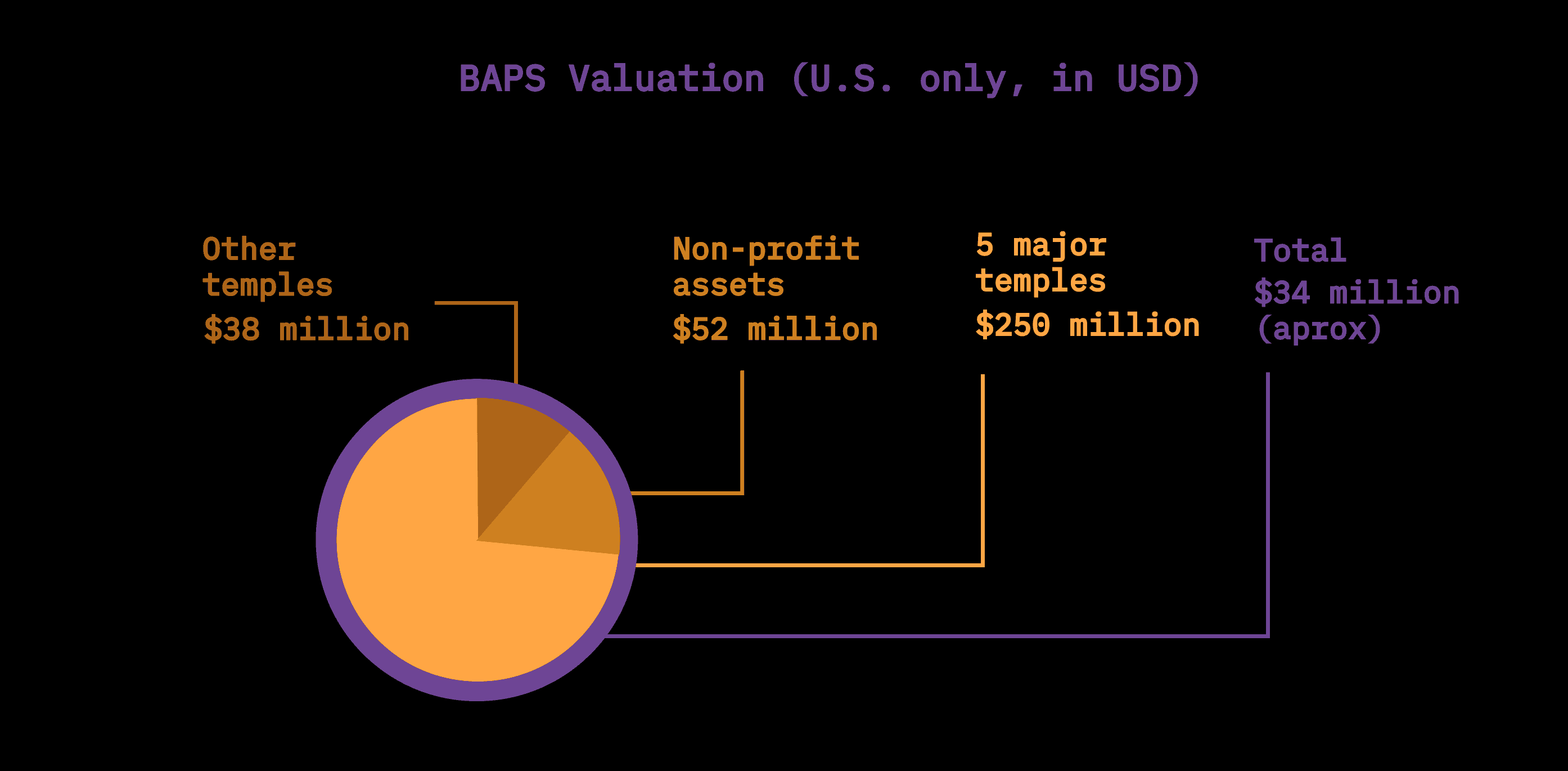
The properties on which the five major temples are built are owned by LLCs and are, at present, valued at close to $250 million collectively. Other temple properties across the country are valued at at least $35 million collectively.80
BAPS’s organisational complexity belies a complete financial picture and shields it from accountability. Nonetheless, just from the non-profits to property valuations, the assets of BAPS in the US are close to $340 million. This is a conservative estimate that does not include the monetary value of its hundreds of LLCs, nor its assets worldwide. BAPS also benefits financially from its tax-exempt status, saving millions in tax dollars. Given that former temple workers were allegedly paid under $2 an hour, BAPS has no doubt saved even more millions in labor costs for constructing these grand temples.
BAPS claims that millions of volunteer hours are behind these massive temples without any mention of the actual workers who built them. This sells short both the devotees who might volunteer with a sense of selflessness and certainly the workers, for whom it is a job, and not a matter of faith.
Worker Experiences
Volunteerism
Speaking on the court case, Swami Brahmaviharidas, who has met Modi at least seven times, said “Wherever we build temples, they are built out of love, they are built out of faith and devotion and with a spirit of volunteerism.”81
BAPS touts that 12,500 volunteers built the Robbinsville temple, and that 1.3 million volunteer hours went into the Atlanta and Houston temples.82 One of these volunteers, Mauktik Dave, says that, “I do not feel as if I am providing my time or energy towards a cause; rather, I have been gaining things from performing this seva [service]. Truly, the imperfections in Akshardham - being built by volunteers - are what make it a perfect home for God.”83
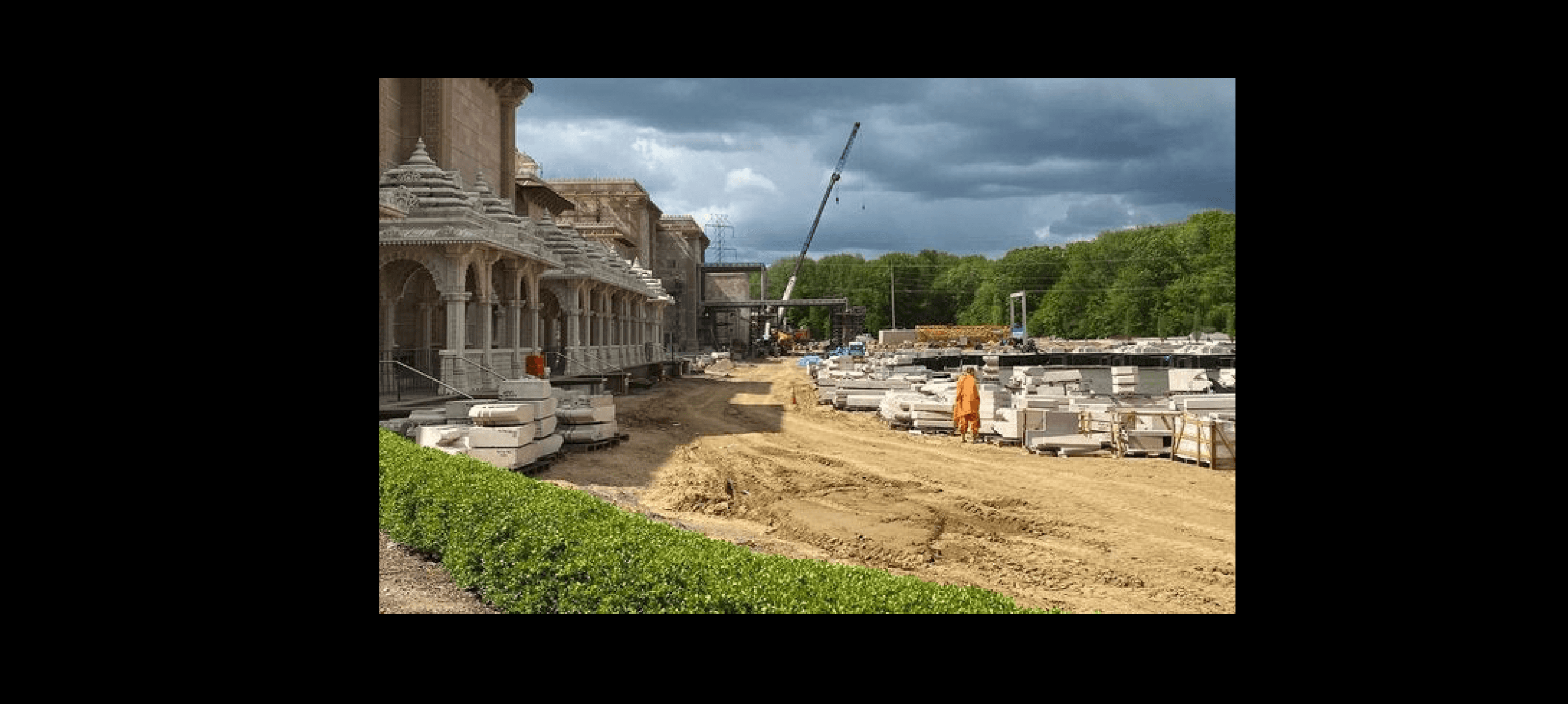
Countering this fanciful volunteer narrative, plaintiffs in the class action suit against BAPS entities allege grueling and underpaid working conditions. Their tasks included cutting stones, laying stones, removing garbage, road work, dipping stones in chemicals, and other tasks.84 They were isolated and lived with the constant threat of retaliation against them and their families, with their passports confiscated.85 They were explicitly forbidden from speaking to any visitors to the temple, and their movements were severely restricted.86
Silicosis
Stone carving, which is the decorative aspect for depictions of gods, is highly specialised work, and claiming that this is done by volunteers further undermines this traditional and skilled community knowledge. However, without adequate protective gear and increased mechanization, stonework can cause silicosis, a chronic and terminal illness. Exposure to dust from cutting stones and chemical solutions is widespread in this industry, having led to thousands of painful deaths.87
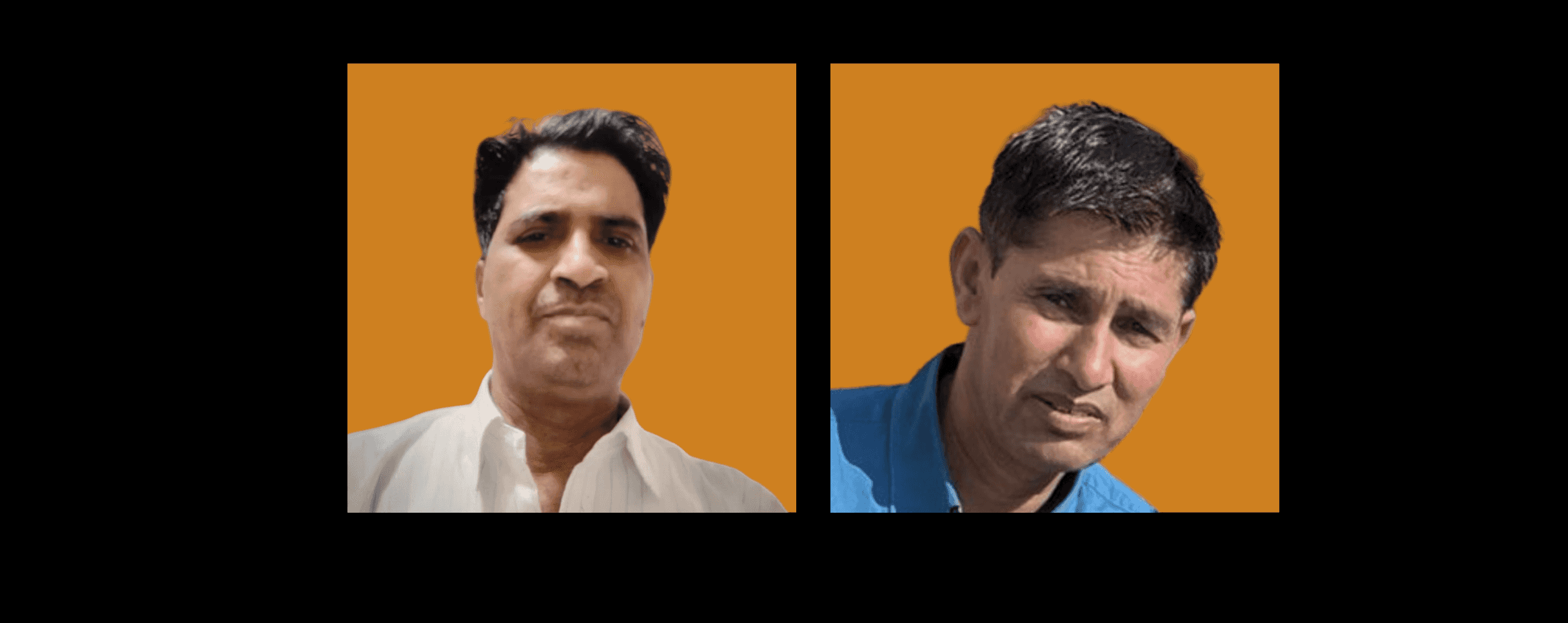
After their rescue, several people were diagnosed with silicosis. Ramesh Chandra Meena and Devi Lal both passed away in 2025 from silicosis.88 Four other rescued workers - Bhagwandas Chamar, Ghanshyam Singh, Pankaj Khant and Gautum Singh - who are part of the class action suit have also passed away after exposure to silica.
Given their exposure to silica dust at the construction site, the remainder of the rescued workers now live with the risk of developing silicosis and respiratory illness, and shortened life expectancies as a result. None of these fatalities or morbidities have been acknowledged by BAPS.
Repeat Offender
The New Jersey Department of Labor (NJDOL)’s Division of Wage and Hour Compliance conducted site visits at the BAPS Temple in Robbinsville and the BAPS Temple in Edison in April 2021. These inspections found that the contractor, Cunha Construction Inc., was paying workers in cash off the books and did not have workers’ compensation insurance.89 NJDOL issued a company-wide stop-work order to Cunha’s Construction Inc. and owner Nuno Cunha based on repeated and ongoing violations of state labor laws. This inspection was the first time the NJDOL has used its authority to pause all work by a single entity rather than on a per-project basis. Based on a preliminary search on the internet, there is no update available in the public domain on who BAPS hired after the raid, and whether Cunha has resumed operations.
Another BAPS-related construction company, “My Baps Construction Corp,” has a similar history of labor abuse. In 2014, the Department of Justice indicted Yashvant C. Patel, CEO of My Baps Construction Corp., on four counts of mail fraud and four counts of making false statements in documents. He allegedly paid less-than-union-scale wages to dozens of employees, including undocumented workers, in order to reduce the employer contributions to the benefit funds.90 Mr. Patel pled guilty, and My Baps Construction Corp. filed for bankruptcy.91
Fatalities
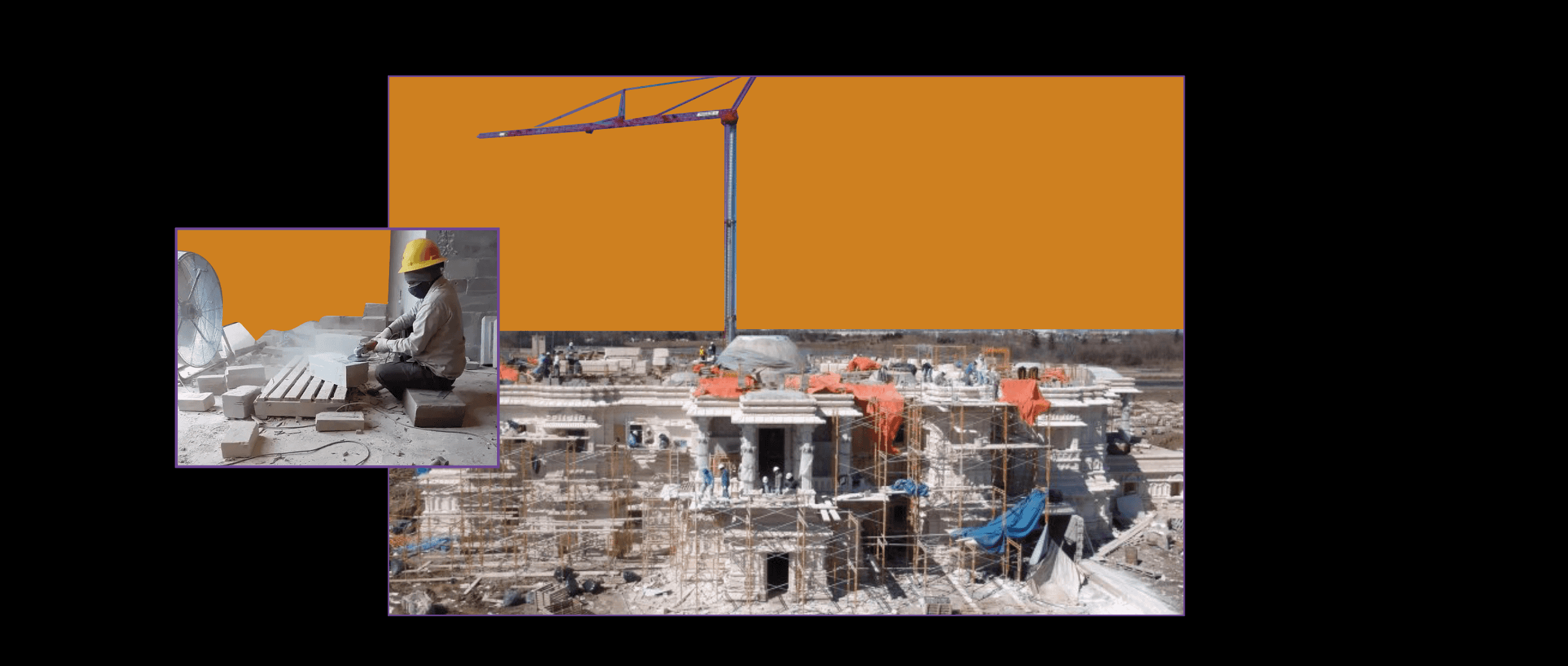
The temple in Robbinsville has been associated with the deaths of at least thirteen people involved in constructing it.
In 2020, Mohanlal, a stonemason who worked on the temple, died due to forced labor.92 Plaintiffs asked for Mohan Lal’s remains to be treated according to his - and not the Defendant's - religious rituals.93 This request from workers on funeral rituals also underscores the difference in faith and identity background of the workers and BAPS, undermining BAPS’s claim that the workers were all "religious volunteers.”
Many workers endured similar conditions, with some returning to India unrecorded. Court documents state “Upon information and belief, at least three other workers — Puran Singh, Bachchu Singh, and Magi Lal — died shortly after they returned to India.”94
Apart from these deaths caused by stone work on the temple, in September 2023, Antonio Marques, a contractor foreman with Flats & Curbs, Inc. lost his life due to an injury at the Robbinsville temple site.95 Years earlier in 2017, a 15-year-old volunteer tragically died after falling 45 feet at the temple site.96
As noted above, six other rescued workers who were part of the class action suit have passed away from illnesses after exposure to silica - Ramesh Chandra Meena, Devi Lal, Bhagwandas Chamar, Ghanshyam Singh, Pankaj Khant and Gautam Singh.97 Gajendar Kumar, tragically died by suicide in India after struggling with addiction and prolonged mental stress.98
Given that BAPS continues to build temples, it is unclear whether this practice of immigration fraud and forced labor is still ongoing.
A Reputation Cultivated, A Reckoning Pending
Given BAPS’s careful construction of its public image, the FBI raid and the civil suit present a giant blow to its reputation.
BAPS has responded by undertaking aggressive building of political clout and public demonstration of its ties to powerful politicians - ranging from Prime Minister Modi to Vice President JD Vance. Their assets in the United States continue to grow, being valued conservatively at around $340 million.
Their expansion in the United States continues with temples in Massachusetts, North Carolina and Minnesota, following the same patterns of emphasizing volunteer labour, operating through multiple linked opaque entities and all while being tax exempt. Yet if we go by NJDOL’s stop work order and the plaintiffs' testimonies, there are likely hundreds of workers involved in these new projects, their living conditions and terms of payment unknown.
Although BAPS has a big and growing footprint in the United States‚ ranging from hundreds of limited liability companies, to multi-million dollar charities to high value tax exempt properties and its lobbying spend—its ultimate authority is Keshavbhai Patel, their Mahant Swami Maharaj and the sixth spiritual successor of Bhagwan Swaminarayan, who is mostly based out of Ahmedabad in India.
Whatever Keshavbhai Patel’s honorific title and spiritual authority within BAPS, in the court of law, he is no higher than equal to the plaintiffs, Rupa Ram, Khima Ram Rebari et al. and both must be treated on equal footing by the law. Despite all of BAPS’s growing fiscal power and courting of political patronage, the allegations by the plaintiffs remain standing, with a demand for a jury trial in the United States District Court for the District of New Jersey.
Summary and Key Findings
- Structure: BAPS has a complex organisational structure - reflected in the defendants being individuals, non-profits and limited liability companies (LLCs) - built as a political organisation, not just a religious organisation.
- Bipartisan influence: BAPS courts influence of U.S. politicians across parties - Democratic and Republican, in a manner designed to be noticed, to enhance its reputation.
- Inauguration as Spectacle: Two and half years after the raid, BAPS inaugurated the New Jersey temple, with US government officials - Steny Hoyer (D-MD) former House Majority Leader, Frank Pallone (D-NJ), Raja Krishnamoorthi (D-IL) and Ro Khanna (D-CA) - playing a key role in legitimizing BAPS.
- Trump Administration: Tulsi Gabbard, Director of National Intelligence in the Trump administration and JD Vance, the Vice President of the United States have recently visited the Robbinsville and Delhi temples respectively.
- Modi Access: After the raid, BAPS has publicised its close relationship with Prime Minister of India, Narendra Modi, publicizing at least seven personal meetings with the Prime Minister - in Delhi, South Africa and Paris.
- Nonprofit Wealth: Three major non-profits linked to BAPS — BAPS Charities, BAPS Aksharpith and BAPS Endowment — have grown over five-fold in their assets over the past fifteen years, currently valued at around $52 million.
- 251 linked LLCs: State registries of the six states with major temples and defendants in the case — Delaware, California, Georgia, Illinois, New Jersey and Texas — have 251 LLCs that are likely linked to BAPS.
- Total Assets: BAPS assets held by its non-profits and property-owning LLCs are estimated to be close to $340 million.
- Labor Exploitation: BAPS emphasises volunteer labor of devotees in constructing temples, but plaintiffs detail grueling and underpaid work done in severe conditions of isolation and threat of retaliation.
- Lives Lost: Thirteen people have lost their lives constructing the New Jersey temple - Mohanlal, Puran Singh, Bachchu Singh, Magi lal, Ramesh Chandra Meena, Devi Lal, Bhagwandas Chamar, Gajendar Kumar, Ghanshyam Singh and Pankaj Khant from India, as well as Antonio Marques (contractor foreman with Flats & Curbs, Inc. due to injury) and a 15 year old volunteer (falling from 45 feet at the temple site).
- Repeat Offendors: BAPS's contractors have a documented history of labor violations. New Jersey Department of Labor (NJDOL) issued a “stop work order” for BAPS’s contractor Cunha Construction Inc., after visiting its Robbinsville worksite in 2021. In 2014, the Department of Justice indicted Yashvant C. Patel, CEO of My Baps Construction Corp., for paying less than union scale wages to dozens of employees and not contributing to benefit funds.


